
Rizz - AI Dating Assistant
Ihor TymarshaLifestyle
4.652.00 Reviews
- Version
- 1.1.8
- Installs
- 100.00K
- Age Rating
- Everyone
Screenshots
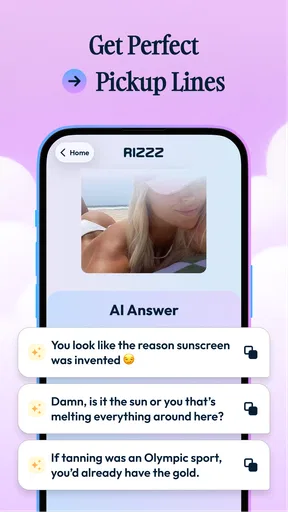
Our Review of Rizz - AI Dating Assistant
 Analysis by Appyee
I tried Rizz - AI Dating Assistant as a practical Lifestyle app rather than treating it like a magic dating shortcut. Its main idea is simple: help you shape replies that fit the way another person communicates. That makes it most useful in the awkward middle ground between “I know what I want to say” and “I have no idea how to say it without sounding strange.”
My first impression was that the app is aimed at reducing hesitation. Instead of replacing your conversation, it is meant to help you adjust tone and wording around the person you are messaging. That distinction matters. A polished line can open a conversation, but it cannot create genuine interest or make an incompatible match work.
Developed by Ihor Tymarsha, the app is free to start and is rated for Everyone. It has reached over 100K installs and holds a 4.6 average from around 12K ratings, which suggests that the basic idea has found an audience. I would still treat those numbers as a sign of interest rather than proof that every suggested reply will suit every situation.
What the assistant is really useful for
The strongest use case is not producing a dramatic pickup line. It is helping me move from a rough intention to a message that sounds more deliberate. If I want to be playful without being too forward, curious without sounding like an interview, or direct without being cold, that framing gives the assistant a clearer job.
That focus on communication style is more valuable than a collection of generic one-liners. Dating conversations change quickly. A message that works in a lively exchange can feel intrusive after a short reply, while a cautious message can seem uninterested when the other person is clearly joking. The app’s concept acknowledges that tone depends on the person and the moment.
I found it helpful to decide my own intention before using any suggestion. For example, I might want to ask someone about a hobby, acknowledge a delayed reply, or suggest meeting without putting pressure on them. Once I know that, an AI assistant can help with phrasing. Without that decision, it is easy to accept a clever sentence that does not actually represent me.
A useful workflow is to write a plain version first. I might type, “I enjoyed talking with you and would like to continue this over coffee.” Then I can use the assistant to make it warmer, more casual, or slightly more playful. This is better than asking for an impressive message from nothing because the final result still starts with my own meaning.
Where it fits better than ordinary dating advice
Traditional dating advice often gives broad rules: be confident, ask open questions, avoid overthinking, and show interest. Those ideas can be sensible, but they do not solve the immediate wording problem. Rizz is more hands-on because it works at the point where a message is being composed.
It also has a different role from a standard keyboard or grammar checker. A keyboard can correct spelling, and a writing tool can make a sentence clearer, but neither is specifically centered on the social temperature of a dating conversation. Here, the useful question is not only whether a sentence is correct; it is whether it sounds like the right response to this person.
That said, I would not choose it over direct communication when the message is emotionally important. If I need to apologize, set a boundary, explain that I am no longer interested, or discuss consent, I would write carefully myself. Those moments require responsibility and context, not just a smoother sentence.
A realistic evening with the app
Imagine matching with someone who replies enthusiastically at first, then sends a short answer after work. I might be tempted to assume they are losing interest and send something defensive. A better approach would be to pause, describe the situation honestly, and ask for a light, non-demanding response. The assistant may help me avoid sounding accusatory, but I still have to choose whether sending another message is appropriate.
In that scenario, the most useful feature is not a particular phrase. It is the opportunity to compare tones before I send anything. A playful version may work if the conversation already has that energy. A simple question may be safer if we barely know each other. A direct invitation may be reasonable if the exchange has been consistent. The trade-off is that more options can also encourage overthinking.
My practical tip is to set a limit: review a couple of alternatives, select the one closest to how you normally speak, and edit it before sending. If I keep regenerating messages, I am no longer improving communication; I am postponing it. The app works best as a short editing stop, not as a place to live inside the conversation.
Trust, controls, and moments that need care
Because this app deals with dating messages, trust is not a side issue. The text I enter may include private details about me or another person. I would therefore use it with the same caution I apply to any AI writing service: remove names, phone numbers, workplace details, addresses, intimate images, and anything that could identify someone unnecessarily.
I also would not paste an entire conversation automatically. A short excerpt is usually enough to explain the tone I need. Before sharing text, I can rewrite identifying details into neutral labels such as “they” or “my match.” That small habit gives me more control while preserving the context needed for a wording suggestion.
The app is free to download, with in-app purchases ranging from $7.99 to $39.99 per item. That makes it important to understand my own usage before paying. If I only need occasional help with a difficult message, the free experience may be enough for my habits. If I use it frequently, I would first check what a purchase unlocks and whether that benefit genuinely changes my workflow.
I would also review the visible choices presented during setup and whenever the app asks for access or information. I do not treat a convenient sign-in or a quick permission prompt as something to accept automatically. The safest approach is to read each screen, decline anything unnecessary, and use account controls where available to manage what I have shared.
That advice is especially relevant because dating content can be sensitive even when the message itself looks harmless. A screenshot may contain a profile name, a location clue, or a personal disclosure. Before bringing it into an AI tool, I ask whether the app needs that detail at all. Usually, it needs the wording and general context, not the person’s identity.
How much agency the user keeps
The app’s value depends heavily on whether I remain the decision-maker. I would never send a generated reply without reading it aloud or at least checking whether I would actually say it. AI tends to smooth language, and smooth language can become unnatural when it is too polished for the relationship.
One of the better ways to preserve my voice is to use the result as a draft. I can shorten it, add a specific detail from the conversation, or remove exaggerated confidence. If the suggested message could be sent to almost anyone, it probably needs more of my personality before it goes out.
There is also a fairness question around matching someone else’s communication style. Adapting tone can make a conversation easier, but imitating a person too closely can feel performative. I would use the app to become clearer, not to manufacture a personality or manipulate someone into responding.
This is where the app is not the right choice for everyone. If you enjoy writing naturally and rarely hesitate over messages, adding an AI step may make dating feel more mechanical. People who prefer private, offline reflection may be better served by drafting in their normal notes app. Likewise, anyone looking for a complete dating coach, relationship counselor, or emotional support tool should not confuse a message assistant with those services.
Version, access, and everyday friction
The current version is 1.1.8, and it supports devices running Android 7.0 or later. That broad compatibility is useful if I am using an older Android phone, although the experience can still depend on the device, keyboard, and the way I move text between apps.
The main friction is the extra step between receiving a message and replying. I have to decide what context to provide, review the suggestion, and then make it sound like me. That is worthwhile for a delicate conversation, but excessive for a simple “How was your day?” Overuse can slow down exchanges that would be better served by an honest, imperfect answer.
I would also be careful with timing. If I am upset, jealous, or anxious, generating several versions can make me focus on wording while ignoring the underlying issue. In those moments, I would wait, write the core truth privately, and only then decide whether an assistant adds anything. No tone adjustment can fix a message sent before I know what I actually want.
For people who date across different communication styles, the app may be more useful when used for interpretation rather than performance. I can ask myself whether a short reply is truly dismissive or simply normal for that person. The assistant may help me prepare a neutral follow-up, but I should avoid treating its wording as evidence of someone’s feelings.
Who should try it, and who should skip it
I would recommend trying it if you regularly freeze before sending a message, struggle to balance warmth and confidence, or want a second look at a reply that feels socially delicate. It can also help people who communicate well in person but become overly formal or vague in dating chats.
I would skip it if you expect guaranteed matches, instant chemistry, or lines that bypass the need to listen. It is also a poor fit if you are uncomfortable entering any conversation context into an AI service, even after removing identifying details. In that case, a private draft and a trusted friend may be a better alternative.
My most useful rule is to give the assistant a narrow assignment: preserve my meaning, adjust the tone, and avoid exaggeration. I would then check three things before sending: does it sound like me, does it respect the other person’s space, and does it make the next step clear? If any answer is no, I edit it or leave it unsent.
After spending time with it, I see Rizz as a focused writing companion rather than a dating solution. Its appeal comes from helping with the small but real problem of matching tone to another person. The free starting point makes it easy to test, while the paid items mean I would not spend money until I knew I was using the assistance often enough to justify it.
My cautious verdict is that the app is worth trying when your problem is wording, not intention. I like it most when it helps me express something I already mean in a calmer, more natural way. I like it least when it tempts me to outsource personality, send overly polished lines, or keep analyzing a conversation that needs a straightforward human response.
Used with short, anonymized excerpts and careful review, it can reduce the pressure around dating messages without taking away my responsibility. That balance is the reason I would recommend it to a hesitant texter, but not as a substitute for judgment, honesty, privacy awareness, or genuine connection.
Verdict
Strengths of Rizz - AI Dating Assistant
- Suggests personalized replies for different dating conversations.
- Helps break the ice when you are unsure how to start chatting.
- Can adjust suggestions to match a chosen tone or situation.
- Useful for polishing messages before sending them.
- Supports users who struggle with dating-app conversation anxiety.
Limitations of Rizz - AI Dating Assistant
- AI suggestions may sound generic or unlike your natural personality.
- Some features may require a paid subscription or in-app purchase.
- Sharing chat context can raise privacy concerns for sensitive conversations.
- Advice may miss sarcasm, flirting cues, or important relationship context.
- Overusing generated replies can make conversations feel less authentic.
Similar Picks in This Category
View All
SmartThings
Samsung Electronics Co., Ltd.4.6

Google Home
Google LLC4.0

Pinterest4.2

Astrotalk - Talk to Astrologer
Astrology & Horoscope4.7

My Verizon
Verizon Consumer Group4.5

Samsung Wallet (Samsung Pay)
Samsung Electronics Co., Ltd.4.1
Frequently Asked Questions
What is Rizz - AI Dating Assistant, and how does it work?
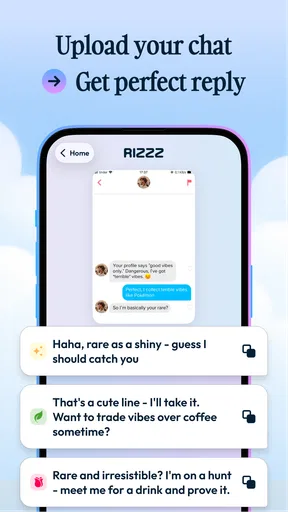
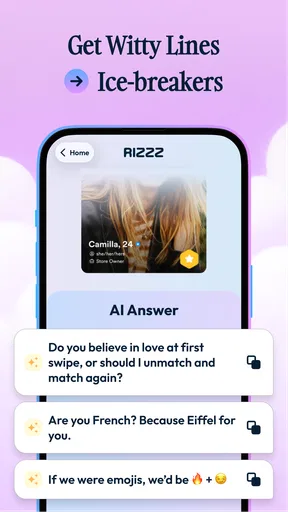
Rizz - AI Dating Assistant is designed to help users create replies, opening lines, and conversation ideas for dating apps and social chats. You can generally provide a screenshot or paste a message, then ask the app to suggest a response in a selected tone, such as funny, confident, flirty, or casual. It is best used as a writing aid rather than as a replacement for your own personality or judgment.
Is Rizz - AI Dating Assistant free to download and use?
The app may be free to download, but some features can be limited behind subscriptions, credits, or in-app purchases. Before starting a trial, check the current pricing, billing frequency, renewal terms, and cancellation instructions shown in the App Store or Google Play listing. Free access may also include limits on generations, available styles, screenshot analysis, or other advanced tools.
Does Rizz - AI Dating Assistant protect my privacy and personal messages?
Because the app may process screenshots, copied conversations, profile details, or other personal information, privacy deserves careful attention. Avoid uploading sensitive data such as phone numbers, addresses, financial information, private images, or identifying details about another person. Review the app’s privacy policy and permissions to understand how information is collected, processed, stored, and shared before using its AI features.
Can Rizz - AI Dating Assistant guarantee better matches or successful dates?
No dating assistant can guarantee more matches, replies, or successful dates. Rizz can make it easier to overcome writer’s block and may suggest more engaging wording, but the result depends on the conversation, the other person’s interest, and how naturally you use the suggestion. Treat generated replies as drafts, edit them to sound like you, and communicate honestly rather than relying on automated messages.
Is Rizz - AI Dating Assistant suitable for everyone, and are there any limitations?
The app is primarily intended for adults who use dating or social platforms, and users should follow the age requirements and terms of the services where they communicate. AI suggestions can sometimes sound generic, overly confident, inaccurate, or inappropriate for the situation. The app may also require an internet connection and may not support every dating platform equally. Always review a generated message before sending it.
